
About the Artist
David Palmquist is a painter working at Vernon Street Studios in Somerville, Massachusetts. Born in Escanaba, Michigan, he spent his formative years in Minneapolis, MI where his fascination with form and function began early. By immersing himself in sculpting, drawing, maps and collage, he developed a dual skillset and penchant for both creativity and structure. Although David graduated with a bachelor’s degree in finance from North Park College in 1994, his art practice was always present, taking extracurricular art classes whenever he could. In 1996, he relocated to the Boston area and later began showcasing his work as part of Brookline Artists’ Open Studios.
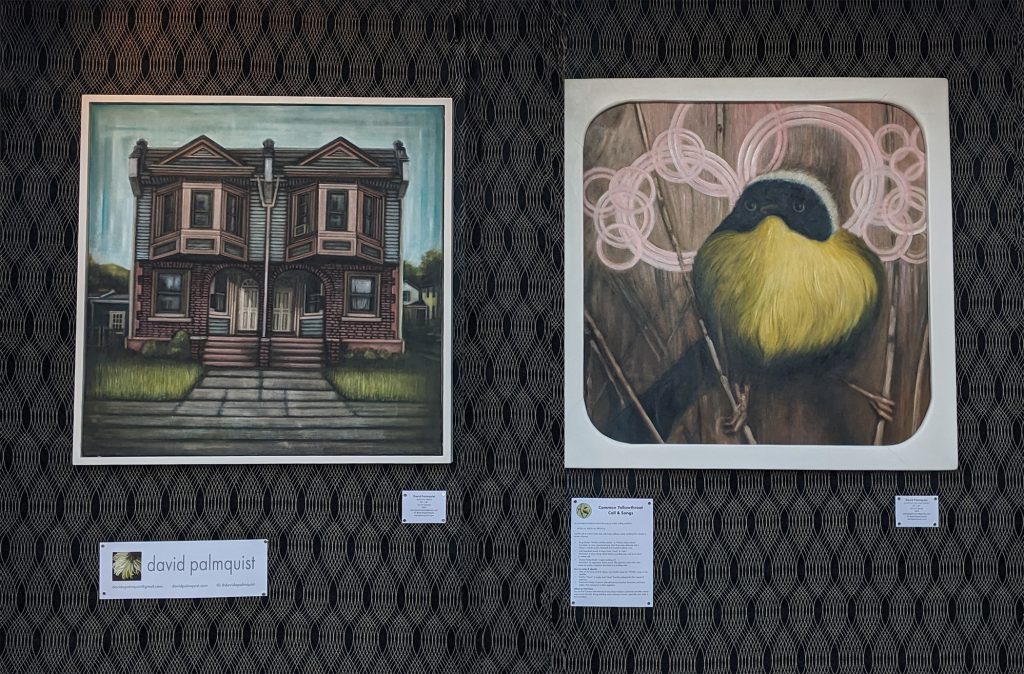
While he remains unconstrained to any specific mediums or subject matter, his predilection for order carries through his practice in the form of graphing, pixilation, and exaggerated definition. Inspired by the works of Chuck Close, David Hockney, Gerhard Richter, Ed Rusha and Mark Rothko, he is drawn to subject matter that abstract themselves into smaller divisions as well as magnified images that reveal a more dramatic perspective. As illustrated in his Satellite and Hi-rise Modular series, he offers a unique lens where lines are blurred, details are melded, and our viewpoint altered. By delving into these concepts of space and perception, he offers a different point of reference; one where, when viewed on a different scale, conveys another reality.
David has been an artist at Vernon Street Studios since 2005 and participates in the Somerville Open Studios. He is a member of the Copley Society of Art and has shown his work at various regional institutions.

Artist Contact information:
[email protected]
davidpalmquist.com
IG @davidapalmquist
Interview with the Artist
Q: When did you first get interested in art? What is your first “creative memory”
A: Although I don’t recall my first creative memory, I do recall some early failures, e.g.:
• A ‘sail boat’, constructed without designs, and held together primarily with caulk
• An Apple 2 vector image of a dragon with syntax errors that was never successfully debugged
• A crayon-drawn map that only faintly resembled the atlas it was copied from
But luckily, I also recall some early failures that turned out to be successes. In 5th grade our class made cut paper and pen collages of city landscapes. We each received one large, and three small, sheets of colored construction paper. I immediately cut a wildly curving line into the largest sheet of paper with my scissors before learning it would need to serve as the background support. As a result, I needed to mend the cut by pasting smaller pieces of paper over the cut, which then formed a serpentine outline of the city skyline. Had I not needed to mend the cut I’m certain my collage would not have had the wonky but wonderful organic movement that resulted.
Q: You have your BA in finance, but you obviously have a creative soul. Are you a self-taught artist or did you receive formal art training?
A: I was lucky to attend elementary, middle and high schools that each offered art classes and other special programming. It was these early experiences in art that got me hooked. And although I didn’t earn the credits necessary for a degree in art, I was fortunate to take quite a few art courses in college.
Q: You relocated to the Boston area in 1996. A few years later you began showcasing your art. How did this evolution begin? Was art already a part of your creative life or was this something you discovered here in Boston?
A: Art definitely preceded my relocation, but it was the local open studios here that encouraged me to show my work and prompted me to seek a studio at Vernon Street. Although the creation of art can be a very solitary process (which I enjoy) it’s also very nice to be surrounded by a community that encourages, supports and appreciates art.
Q: How long have you been at Vernon Street?
A: I’ve enjoyed 20+ years at Vernon Street now; my first Somerville Open Studios, as an exhibiting artist, was in 2005.
Q: Who and/or what inspires you as an artist?
A: I often reference well-known painters like Chuck Close, Gerhard Richter, David Hockney and Ed Rusha as inspirations, but my interests are expansive and somewhat difficult to categorize neatly. For example, ‘LED ROTHKO’, which is included in the Inside-Out exhibit, is inspired by James Turrell and Mark Rothko and made with LED lights. Although I remain unconstrained to any specific mediums or subject matters, I enjoy a certain predilection for order; and this tends to carry over into my visual art in the form of graphing, pixilation, and exaggerated definition. I am drawn to images that lend themselves to being segregated into smaller divisions or to images that when magnified reveal a more dramatic and surreal reality. Further, I enjoy morphing natural images with abstract and geometric forms, am drawn to the simplicity of modern design, and am fascinated by observations on how well or poorly manifested ideals exist within reality.
About the Inside-Out Gallery
Initiated in 2009, The Inside-Out Gallery is located in the CVS Window in Davis Square, a unique space that allows the public to view an eclectic array of works from artists and local organizations each month. The mission of the Somerville Arts Council is to cultivate and celebrate the creative expressions of the Somerville community. Through innovative collaborations and quality programming we work to make the arts an integral part of life reflective of our diverse city.